In times of economic constraints, departments that do not directly and measurably contribute to profit are often downsized or shut down. The same is true for non-profit organisations in economic challenging times who depend on philanthropy to survive.
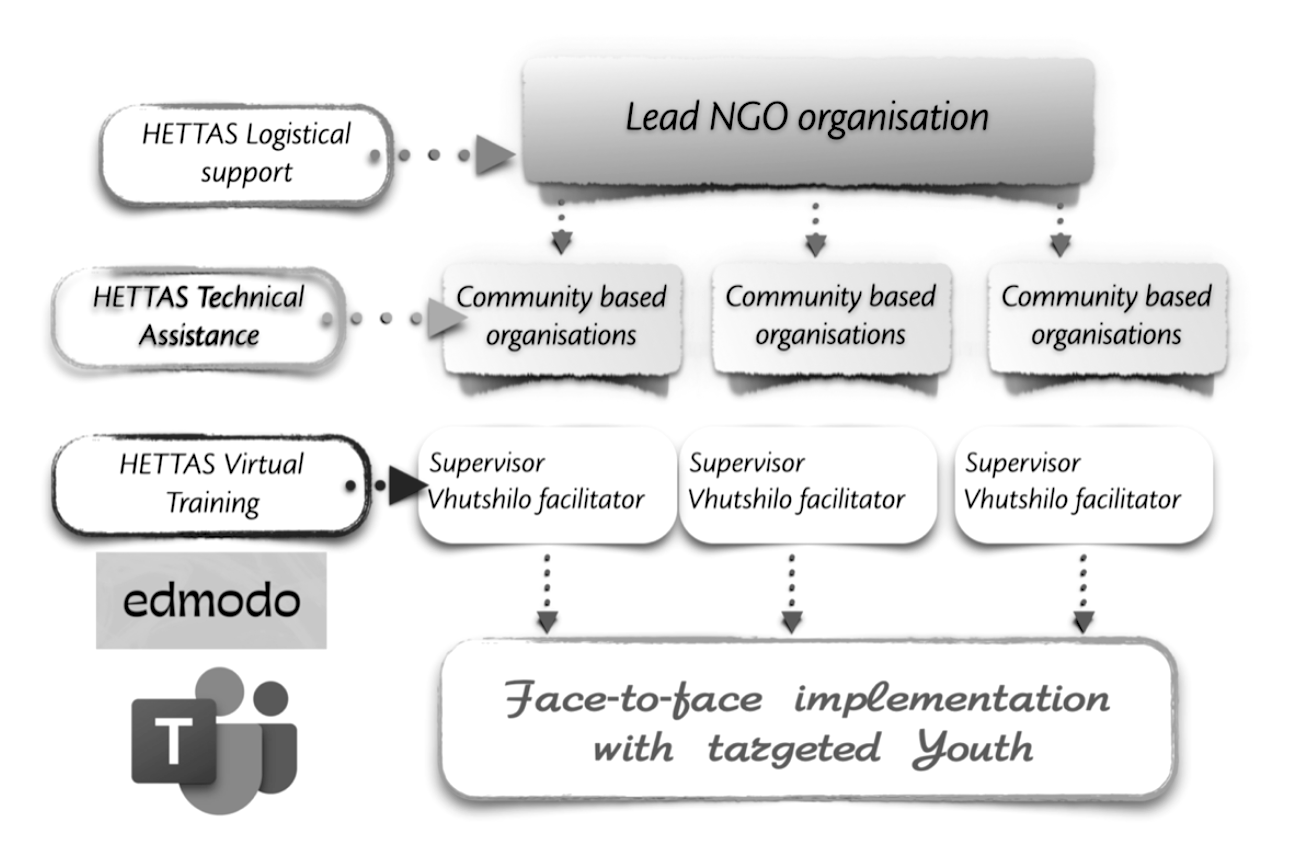
For Health Education Training and Technical Assistance Services (HETTAS), the lockdown announced in March 2020 heralded the inevitable end of the organisation. HETTAS solely relies on donor funding and its HIV prevention offering is largely centred around three curricula aimed at youth beneficiaries between the ages of 10 and 18. HETTAS would conduct face-to-face training with youth facilitators — under supervision of the NGO that employed these facilitators — who would also implement the training with these young OVC in a face-to-face setting. As with other training organisations, this mode of delivery was suddenly off limits. The staff at HETTAS had no alternative but to start looking at other forms of employment and freelancing work.
Formed in 2007, HETTAS had a staff of 13 by 2009 and was working predominantly in the peer education field to conduct HIV prevention education. It had developed Vhutshilo 1 (10-13), Vhutshilo 2 (14-18) and later Vhutshilo 3 (14-18 HIV positive youth). These manuals with additional resources were taken into the most remote parts of each of the nine provinces where trained facilitators would implement directly with the youth in and out of school settings.
The impact of the lockdown
With original funding through the Harvard School of Public Health and the CDC, it then received funding from USAID, Global Fund, American Council on Education and the Western Cape Government. But by 2012, funding for large projects has dried up and HETTAS began retrenching staff. A small core of three remained who were committed to pursue additional projects to keep HETTAS going. Trainers were contracted when needed.
From 2012 to 2019 HETTAS worked on several small projects with Global Fund and on updating the manuals to bring them in line with the latest medical research and best practices which was funded by USAID. Then, national lockdown happened. The core staff members at HETTAS starting writing reference letters and updating CV's. During the early numbing silence of the lockdown, they also reached out to old networks and organisations they worked with.
One organisation, FHI 360, had previously contracted HETTAS to train their implementing partners on their HIV prevention curricula and reached out to HETTAS. FHI 360 was researching innovative ways to continue reaching the vulnerable youth they are serving with their projects despite the national lockdown and requested HETTAS to brainstorm some ideas on how the HIV prevention curricula could be presented virtually. A month later HETTAS had developed the first concept document and a month after that, 25 May 2020, had a fully formed proposal ready. If that seems to suggest a linear flow from basic idea to fully formed concept, that wasn't the case. From creating short animations (prohibitively expensive) and using WhatsApp groups for HIV prevention messaging, there were a plethora of conflicting strategies. The fact is that no-one had any idea of what an online HIV prevention intervention would look like or whether it was even possible.
Changing modalities
Apart from one member of HETTAS who had spent an inordinate amount of time researching learning management systems (LMS) and who had drafted the proposal, there was no consensus that any of this was possible. But it was vital to continue, for to let this impossible opportunity go by would mean the end of an evidence-based curricula addressing the most vulnerable to HIV infection.
USAID agreed to fund the three HIV prevention curricula so that they could be reduced in size to better suit an online environment. It was assumed that all communication would be underpinned by WhatsApp groups and that "normal face-to-face" training would resume immediately after the national lockdown was ceased. The reduction of the three curricula to 10 sessions began in earnest as did the search for an online solution. The original idea was to rework the Vhutshilo website into a WordPress platform and then plug a LMS into that for the online component. But the pricing for that kind of approach was simply not feasible.
Part of the online solution had been solved via Phambano's initiative who had given HETTAS access to Microsoft 365 at a fraction of the cost. Microsoft 365 comes with Teams which meant that HETTAS could use Teams to connect remotely with organisations around the country at the same time. Via Teams it became possible to connect small groups from Tzaneen, Johannesburg and the KZN midlands to train in the 'same room'. But the LMS was still not resolved and threatened the entire viability of the project. It all came down to one word when the HETTAS staff member leading the technology component reached out to a colleague who specialised in LMS systems within universities. And that one word was Edmodo.
The final piece of the puzzle
Edmodo must be the biggest open-source LMS in the world that hardly anyone has heard about. User number estimates range between 70 to 140 million around the globe and it provides cutting-edge LMS resources to the poorest schools and adult learner centres in the world. Edmodo also has a crucial additional benefit that is generally lacking even among the top-tier LMS. It is known, among its users, as the Facebook of LMS because it places the ongoing conversation at the centre of how it functions. From that point, resources, articles, videos, assignments and quizzes flow outwards and allow the trainer an ongoing assessment of the participant measured across several interactive contributions. All this is accessible via laptop, tablet, and a smartphone app, only requiring access to data.
Recordings of the day's session are made available to participants so that they can return to parts of the training that may still be unclear. Participants can message the trainers at any time for clarification and private sessions can be arranged with individuals or with the entire organisation. Best of all, the class is locked to anyone who isn't a member but is open to participants for as long as they need it. This is a benefit impossible in the face-to-face iteration and offers the real possibility of no participant being left behind. More importantly, it opens the possibility of cascade training as each class can be replicated for a new group of participants.
The edited curricula were loaded onto the site, additional resources like pictures were made available for download, assignments and quizzes were designed and the HETTAS staff were orientated to the LMS. By January 2021, HETTAS had begun showing the functionality to FHI 360 who had committed to providing data to its implementing organisations and by 1 February the first group of youth facilitators were being trained by HETTAS via the system. In the process, HETTAS became (to our knowledge) the first South African NGO to go fully online in the delivery of HIV prevention education.
By 7 May 2021, 292 facilitators and supervisors have been fully trained in all three of the curricula. Because facilitators work in pairs that means that 140 pairs are already implementing to groups of 20 youth at a time which makes for significant expansion reach.
What happens to HETTAS after this training finishes and youth begin facilitating the curricula is uncertain. But what it does show is that SMMEs, NGOs with limited resources can successfully implement a complex LMS at relatively low cost and with limited resources in the face of a pandemic that ostensibly should make contemplating such a path a thing of implausible fantasy.
South Africa has 25,000 schools in the country. Of these, only 6,000 have access to internet. Imagine if this number could be expanded with zero rated data and a limited number of tablets or smartphones. Imagine what Edmodo (or its latest reincarnation) could achieve in terms of ensuring that learners have a better chance of success, even after a return to the classroom. Imagine the impact on our broken school system if the classroom was always open and a teacher and resources always available.